Friday, February 28, 2014

Take a Twirl Skirt - Vogue 2747

Pattern: Vogue 2747 c. 1991

Pattern Description: An above mid-knee flared skirt with lined yokes, side front and side back seams, and back zipper. Skirt length is around 20-22". Design by DKNY.*

Pattern Sizing: Sizes 14-16-18. I made a size 16.

Did it look like the photo/drawing on the pattern envelope once you were done sewing it? Yes

Were the instructions easy to follow? Yes, very much.

What did you particularly like or dislike about the pattern? I love that it is a lovely flared skirt in a substantial weight and perfect for black boots or heeled oxfords. The corset-like shape of the waist yoke is a great detail.

Fabric Used: 1 -5/8 yards of red brushed twill (former Nautica buttoned tab curtains from Target), 12" (cut down to 9") red zipper from stash, Pellon Shape-Flex (SF-101) woven fusible interfacing, stash fabric for lining, hooks and eyes.

Before Construction: First thing, first, I cut and ripped the drapery panels to make sure the fabric was on grain. I did this on all four sides. I decided to keep the tabs in case I might want to have belt loops on the final skirt. I removed all the buttons from the tops of the panels, 32 in all (16 marbleized one with Nautica written on the "right" side but unmarked on the reverse and 16 clear backing ones for stability) Because these drapes had been up in my apartment for years, months at a time, there was a lot of visible sun fading on the sides facing out. Before I cut the pieces, I had to make sure that the front of the panels used were not affected.

Pattern Alterations or any design changes you made? I was going to cut the skirt longer, but after measuring the skirts in my closet, I realized the 21" finished length should be perfect.

The inside yoke before attaching the lining.

After stitching together the seven pieces for the waist yoke and attaching them to the skirt I was able to wrap the project around my waist. No final garment measurements were provided for this skirt, so there was no knowing how much ease was included. To adjust the width, I decided to cut 1/4" from the back seam allowances, effectively eliminating 1/2" from the skirt circumference before sewing in the zipper.

I fused the woven interfacing to the skirt yoke pieces. This was the first time I've used this type and I really like it, if gives a nice stiffness to the fabric and it fused extremely easily and adhered well.

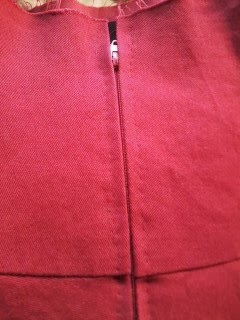
Nearly invisible, right?
After basting on the zipper by hand I decided I liked the minimal look and used a tiny prickstitch, so this is as close as I get to an invisible zipper. Pretty good, right?
It was time to attach the lining. For this skirt, only the yoke is lined so I attached the yoke lining pieces at the top and then folding the edges under I slipstitched the lining over the waist seam and to the zipper tape.


Finishing the skirt; at least for all my skirts, means a hand stitched hem. I prefer handsewing to an obvious stitched line around a skirt. A great tip that I can offer is to use your sewing machine as a hem guide. For a 1-1/2" hem, sew a basting stitch around the hem at the 1/2" mark, this will be the first fold. The stitching gives you the perfect "straight" edge and does half the job for you. Now, you can use a combination of finger pressure on the fold line and steam from an iron to press the fold and shrink out the excess fullness. I find it more enjoyable than using a ruler, a hot iron, and vulnerable fingers to slowly press around a huge circle, measuring all along the way. This way, I just remove the basting threads afterwards. Easy peasy.

Excuse the extra line, which I just ignored.


Would you sew it again? Would you recommend it to others? Yes, I would. This was meant as a quick project with minimal fitting needed and that's what it turned out to be.

Modern knit skirt from Zara with a similar shape.


Conclusion: I love it, a nice swingy red skirt. Funny thing is that I now own four solid red pieces in very similar shades, but different enough that none can be worn together.

*This pattern was secured free during the VA/DC/MD blogger swap!

Saturday, February 15, 2014

2.15.2014 - Sewing Update

Here is what is going on in my sewing life:

Mini-clutch mockup

  • Currently working on the Hot Patterns/Fabric.com Crepe Suzette Clutch pattern (whew! what a name!) Because of errors in the instructions I chose to make a quarter-scale mock up of it first and will work on the real thing today.
  • Today, I am cutting out a muslin of New Look 6145, the shift dress from last post, in a similar silky and shifty polyester to test out the basic pattern before I start adapting it.
Simplicity 5289 from 1972.

  • This past week, I tried on my quick muslin of Simplicity 5289 that I had put together before I moved. I found the armhole to hang too low on the raglan sleeve and am looking in my books and on the web to find a solution. I believe it has something to do with changing the armhole curve in order to reduce length but I would love to see that in writing. Any sources you can direct me to?

  • Once these other projects are done, I will be moving directly onto the Built By Wendy Sew U jeans pattern, bypassing the Colette Clovers*. Instead of mucking around with the paper pattern first, I'm using one of the fabrics I bought for the Clovers, a Fabric Mart stretch poplin, to make a quick and dirty mockup without any alterations. I will be following along with SallieOh's posts on her version of this pattern for inspiration.
*The muslin was problematic and not worth the trouble.

Monday, February 10, 2014

Seeking the Sublime Shift


Michelle Dockery in silk Miu Miu at the Venice Film Festival 2013.

These are the desired features for my ideal shift dress pattern:
    • boat-neck or shallow scoop
    • one piece, subtle flare
    • button closure, if any, eliminating the need for a zip
    • center back seam for shaping
    • full, ¾, or half length sleeves with some kind of wrist treatment, placket or gathering
    • long for possible belting or just above knee
New Look 6145 is the pattern I will use and possibly adapt to create my dress. Patternreview.com shows great reviews.


Here is the fabric for the very first one, a silky (but maybe too shiny) polyester gained from that wonderful DC, VA, MD swap. I'm not sure if it has enough body for what I have in mind. But luckily, no pattern matching can possibly be expected, right?


Here are a few examples I admire:


Clockwise from top left: Lobelia, Christine Phung, and J. Crew

So, are there any design options I should take advantage of like gathers at the yoke similar to the Miu Miu, gathered bishop sleeves (see both below), or the straight 3/4 sleeves of the pattern? Should I make it easy on myself* or shake it up a little?


Eileen Fisher shift dress with neckline, shoulder, and cuff details.

*Why start now, you ask?!

Friday, January 31, 2014

Super Quick Project - Knit Turban

This is officially the last sewn project of 2013.

A few weeks ago, I wrote very quickly about making a turban for bad hair days. At the time, I didn't have any pictures of the project to show, but I do now. Unfortunately, there is no picture of me wearing it. With the current lighting and my dark hair, you just can't see the details. I think to wear a turban well, similar to wearing a cloche, there needs to be some hair peeking out at least. Perhaps, if I buy some hoop earrings and always wear lipstick it would work but not without.

I used this tutorial from Sewing.org. It's very simple and quick and can be made in less than an hour. All you need is about 5/8" yard of fabric. I used an interlock knit but the fabric doesn't even have to be that stretchy, an old solid t-shirt would be fine.


The front is anchored by a loop of fabric creating gathers for visual interest. It is also a perfect resting place for a great broch or some faux peacock feathers if you want to be dramatic.


My dad just happened to have this hat stand!
The three back pleats create structure by being sewn in the ditch down the middle back seam.

Monday, January 27, 2014

Fashion in Film: Camelot (1967)

Director: Joshua Logan
Vanessa Redgrave, Richard Harris, Franco Nero
Music: Alan Jay Lerner, Frederick Loewe
Costume Designer: John Truscott*


This also just happens to be one of my favorite movie musicals, along with The Music Man, Funny Face, Sound of Music, Company, West Side Story, and Sweeney Todd**. The embedded video towards the bottom of the post is a medley of all the songs from Camelot. Enjoy!


Vanessa Redgrave, at her most beautiful, is first seen dressed in white arriving for her first winter in Camelot. Hooded in white fur, bundled in blankets, and wearing white gloves she is delivered to her husband-to-be in a horse drawn carriage. From this image, you can see that the costume design in this film will not be boring.

The majority of the costumes of note in this movie are worn by her character, Guinevere. A variety can be seen in the Take Me to the Fair number seen here.

Designer John Truscott’s costumes for Guinevere ran the gamut from a mustard cowl neck gown to a plain smock with a mesh-like vest (see below) to gleaming gold and burgundy red gowns. The design of the regular day gowns were perfect, as they not only evoked the medieval period of the play but also reflected the contemporary fashions of the late 1960s. The long loose hair, daisy crowns, and long A-line gowns could have been seen on the streets at that time.


A gorgeous Haleen Holt illustration of Truscott’s designs show the variety of looks envisioned for Queen Guinevere.

The headpieces, hats, and hairstyles were highly imaginative and some of the braided styles are amazing. The film displayed Vanessa as a great beauty, important to the plot as this Guinevere is loved/or admired by all of the male knights and Arthur, her king.


Moving onto the true reason for this post: my up close and personal view (at the VMFA Hollywood Costume exhibit) of one of my favorite cinematic gowns, the unique wedding gown of Queen Guinevere.


Costumes of historic English Queens, note the incredible texture.

My favorite angle of the dress with the open sides.

An example of the crochet overdress
The exquisite wedding gown arrives in the movie, lit by candlelight, shimmering out of the darkness. It is designed with a bateau neckline, long sleeves, in an a-line shape with an attached cape that flows over the shoulders and arms and then drops into a large circular train. The overdress is composed of a gown crocheted from fine wool to resemble airy spider webs that had tiny shells sewed into the center of each one. It is open at the side for easy removal and tied with cords.

Underneath is a shimmery kirtle (or cote-hardie) made of something resembling distressed velvet. The third and most dramatic element of the dress, the train, is made from fine mesh embroidered with another loose cobweb design in silver. Along this design, the fabric is embellished with bleached pumpkin seeds tied and hanging every few inches from the design, much like one would expect pearls on a couture gown.


The outfit is breathtakingly beautiful in person. Luckily, this dress is seen in motion in the clip below (it appears at 3:50); however, we do not have the experience of hearing the unique sounds of the seeds as it moves.


More images of the wedding dress can be found at the Fashion Media Arts Council and its own Hollywood Costume review.


An outfit that seems to fit more with the 1981 Arthurian tale, Excalibur, is this gold reptilian-like costume, complete with a lizard-like headpiece. This outfit would have perfectly suited Helen Mirren's Morgana/Morgan le Faye character in the later film much more than the Redgrave earth mother/flower child-influenced Guinevere in 1967.


From sketch to studio costume to film.

An exquisite design constructed of diamond shapes combined to make a monumental armored gown of interlocking diamonds of copper or bronze. The short-sleeved overdress and cape are hinged like chain mail over a long-sleeved gold patterned high-necked gown. It was then topped with a horned lizard-like hood and crown.


Surprisingly, I also found the male costumes, particularly the armor, beautiful. The details as seen in these few photos show an attention to detail so amazing its upsetting to know that it barely was noticed on film. I love the basket weave-like chain mail of the tunic worn under King Arthur’s breastplate and the difference in weight and look of the kind used in the chain mail gorget (cowl) arranged around his neck for protection.


Here is a costume the knight Lancelot Du Lac wore during his boastful song C’est Moi. The shirt is constructed of silk with a smocked waistband and cuffs, both embellished with violet embroidery on the cuffs, waistband, and neckline.

 http://www.julienslive.com/view-auctions/catalog/id/90/lot/38772/?url=%2Fview-auctions%2Fcatalog%2Fid%2F90%2F%3Fpage%3D26

I must confess that the purpose of this post was to document only the wedding dress. However, looking at the film again, I realized the whole production impressed me. This should be no mystery since John Truscott; the costume designer was also the production designer for the film. Unfortunately, Mr. Truscott only designed one other major motion picture because he was considered too extravagant and expensive. However, look at the results!

*John Truscott won Best Costume Design that year for this film.
** The last three all with lyrics by Stephen Sondheim!

Illustrations: Haleen Holt
Images: Bettmann/Corbis, Julienslive.com auction site